
A railroad town since 1875
Asphalt Paving in Colton, CA
Older homes, sandy ground from the old Colton Dunes, and industry around the rail lines.
- Free on-site estimates
- Itemized written quote before work starts
- Base depth and asphalt thickness stated in every quote
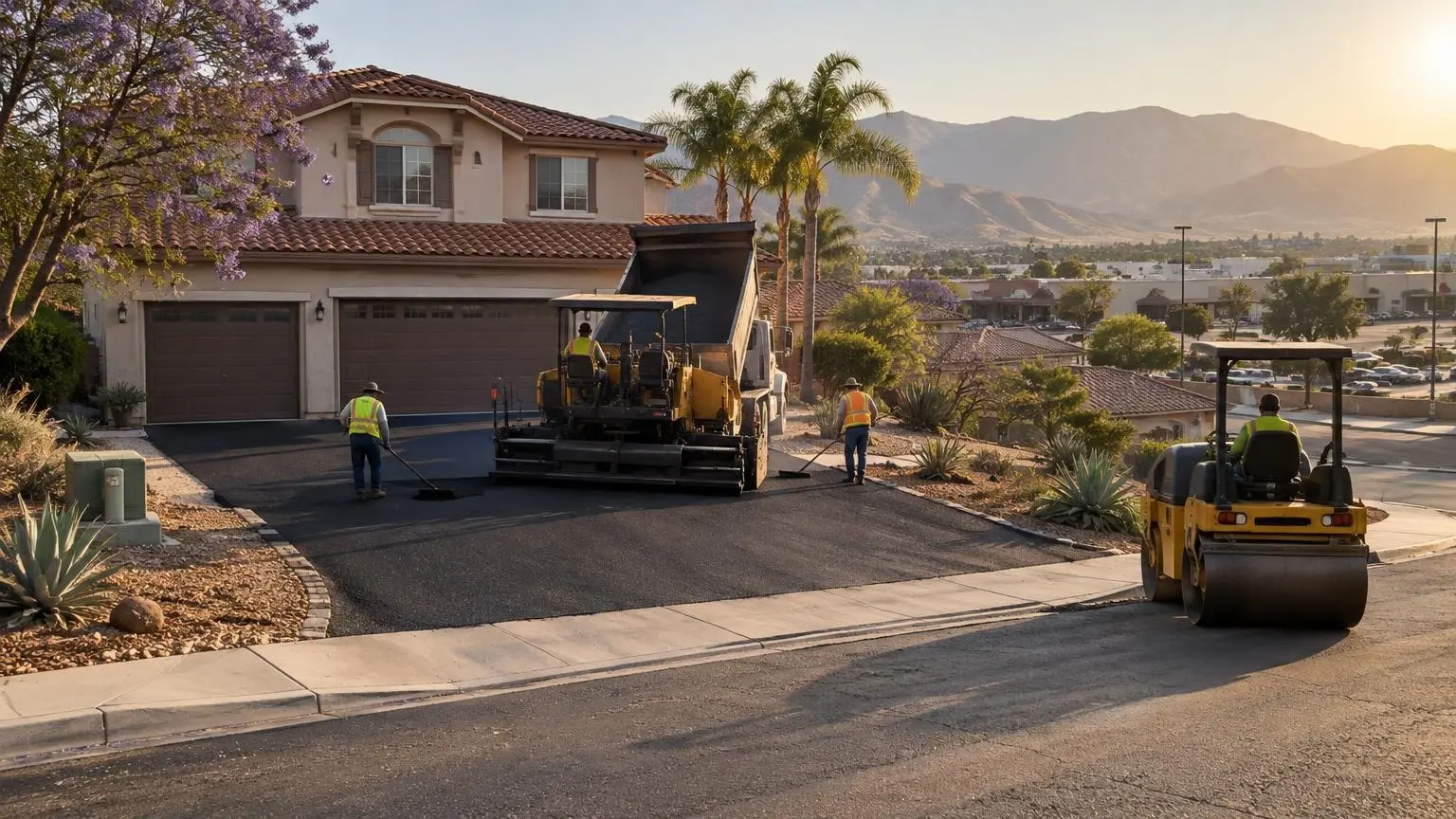
Paving in a Railroad Town
Asphalt paving in Colton works on some of the oldest ground in the Inland Empire. Colton was created in its modern form when the Southern Pacific built east from Los Angeles in 1875, and it incorporated in 1887. Virgil Earp was its first marshal. The city is still defined by rail: Colton Crossing, where the BNSF and Union Pacific lines met at grade, was replaced by a flyover on August 28, 2013.
The Colton Dunes
Colton gives its name to the Colton Dunes, a field of windblown Delhi fine sand that once covered about 40 square miles from Colton west to Ontario and Chino. Only about 2 percent of that habitat remains undeveloped, and the Delhi Sands flower-loving fly that lives there was the first fly placed on the federal endangered species list, in 1993. For paving, the lesson is that much of the ground in and around Colton is fine sand. It drains well but shifts if it is not compacted and confined, so a solid aggregate base is essential.
Older homes
Colton's population grew from 1,285 in 1900 to 3,980 in 1910, and later from 21,310 in 1980 to 40,213 in 1990. That gives the city a mix of century-old homes near downtown and 1980s tracts on the edges. Older driveways often need full replacement; younger ones can usually be sealed or overlaid.
Industry and freeways
Railyards, industrial sites and warehouses surround the rail lines, and the San Bernardino Freeway cuts through what was once downtown; a large part of historic downtown was demolished for it in 1953. Industrial lots near the rail corridors need heavy sections and good drainage.
Slover Mountain and the river
Slover Mountain, once the highest point in the San Bernardino Valley, is within city limits, and the Santa Ana River runs past the city. Low ground near the river can hold water after storms, so grading and drainage are checked before paving.
What Colton owners typically need
- Replacement of old, thin driveways near downtown
- Overlays and sealing on 1980s tract driveways
- Base correction on sandy ground before new paving
- Heavy-duty patching and resurfacing for industrial and rail-area lots
- Drainage fixes on low ground near the river
Colton's industrial areas carry heavy trucks every day, so lots there need heavier sections and more frequent maintenance than residential driveways.
Planning a Colton project
Colton's summers are hot, and its sandy soils dry out quickly. Dry sand can be hard to compact, so we moisture-condition the subgrade before rolling it, which also keeps dust down. For homes, a written quote separates removal, base, paving and edges. For industrial lots, we plan phases around rail and truck schedules.
Call (909) 612-9922 for a free Colton estimate, or
.Colton at a Glance
- Railroad origins. Colton was created in its modern form when the Southern Pacific Railway was built east from Los Angeles in 1875, and it incorporated in 1887. Colton Crossing was replaced by a rail flyover on August 28, 2013.
- Colton Dunes. The Colton Dunes soils are mainly Delhi fine sand. The original dune habitat covered about 40 square miles, and only about 2 percent remains undeveloped.
- Growth spurts. Colton grew from 1,285 people in 1900 to 3,980 in 1910, and from 21,310 in 1980 to 40,213 in 1990. The 2020 census counted 53,909.
Colton Questions
Is sandy soil bad for asphalt?
Not if it is compacted and covered by a good aggregate base. Loose sand under thin asphalt is what causes failures.
Do you pave industrial lots near the rail lines?
Yes, with sections sized for truck traffic and attention to drainage.
My Colton home is very old. Can the driveway be saved?
Sometimes with patching and sealing. If it is sinking or broken up, replacement with a new base is the lasting fix.
Do I need a permit for driveway work in Colton?
Work on your property often does not, but changes to the approach or curb in the public right-of-way usually do. We confirm the City of Colton's requirements before scheduling.
How often should an industrial lot be sealed?
Every two to five years is typical for lots, depending on traffic and sun. Heavy-use lanes may need patching between seal cycles.
Why do you wet the ground before paving?
Sand compacts best at the right moisture. Wetting it helps the roller reach full density and keeps dust down.
Can you repave a driveway with a detached garage at the back?
Yes. Long side drives often need smaller equipment; we look at access during the estimate.
Do you work in older neighborhoods near downtown Colton?
Yes. Many older driveways there need replacement with a proper base, and we take care around old walls and curbs.
Asphalt Paving Near Colton
- Asphalt Paving in Ontario, CA
- Asphalt Paving in Upland, CA
- Asphalt Paving in Rancho Cucamonga, CA
- Asphalt Paving in Montclair, CA
- Asphalt Paving in Chino, CA
- Asphalt Paving in Chino Hills, CA
- Asphalt Paving in Pomona, CA
- Asphalt Paving in Claremont, CA
- Asphalt Paving in Fontana, CA
- Asphalt Paving in Eastvale, CA
- Asphalt Paving in Jurupa Valley, CA
- Asphalt Paving in Norco, CA
- Asphalt Paving in Corona, CA
- Asphalt Paving in La Verne, CA
- Asphalt Paving in San Dimas, CA
- Asphalt Paving in Diamond Bar, CA
- Asphalt Paving in Rialto, CA
- Asphalt Paving in Walnut, CA
- Asphalt Paving in Riverside, CA
- Asphalt Paving in Bloomington, CA