
Tree City USA at the foot of the mountains
Asphalt Paving in Claremont, CA
Mature street trees, foothill lots and neighborhoods that roughly doubled in size in the 1950s and 1960s.
- Free on-site estimates
- Itemized written quote before work starts
- Base depth and asphalt thickness stated in every quote
Paving Among Claremont's Trees
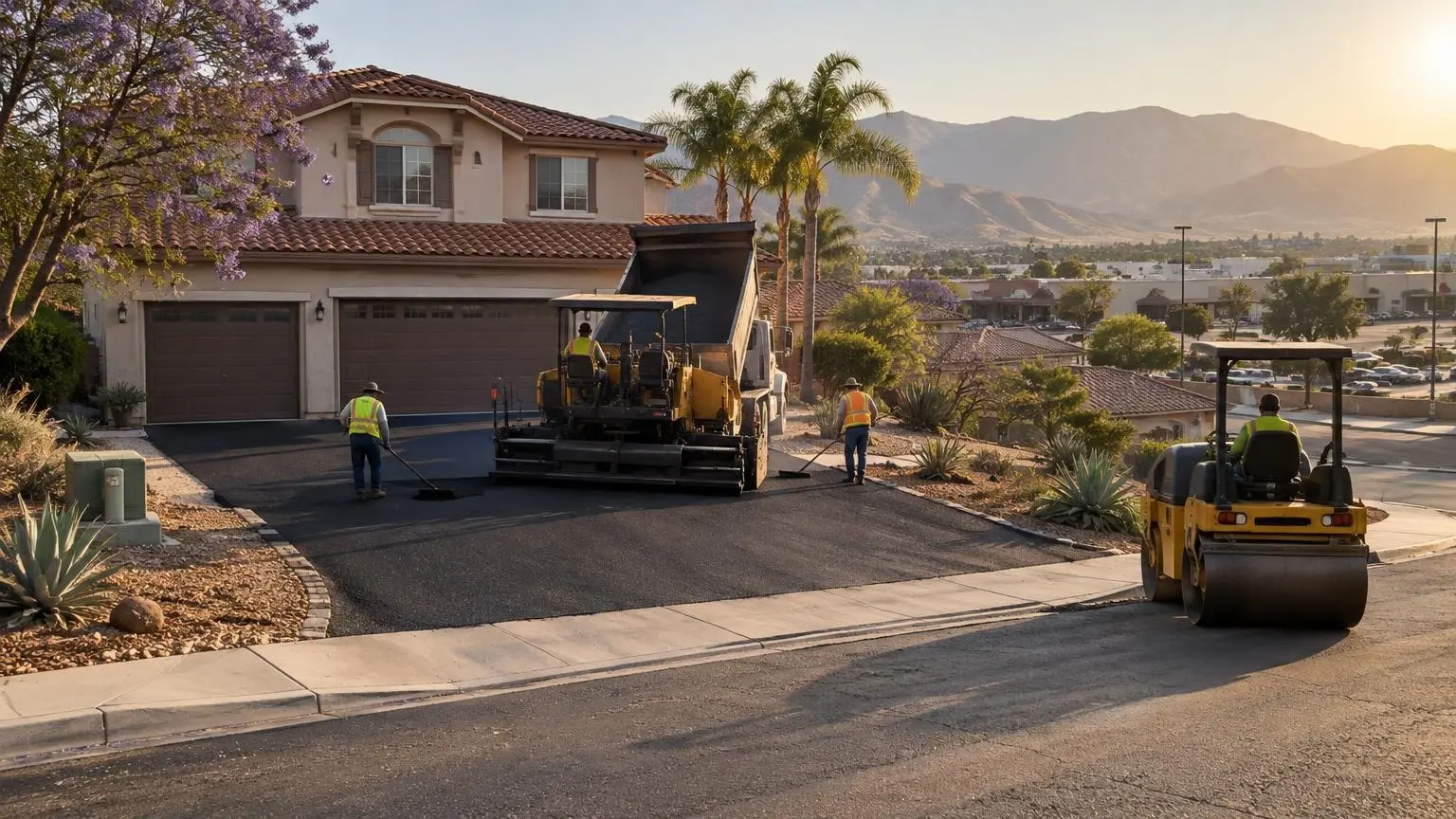
Asphalt paving in Claremont often means working around trees. The city has been a Tree City USA for 22 consecutive years, and many of its streets are lined with mature elms, oaks and other shade trees. Roots lift driveways, and shade slows how fast new asphalt cures. A good job here cuts and rebuilds root-damaged sections without harming the yard more than necessary.
Housing from the 1950s and 1960s
Claremont grew from 6,327 residents in 1950 to 12,633 in 1960 and 24,776 in 1970, roughly doubling each decade, and had 37,266 people in 2020. Many homes from that period still have their original driveway base. When the asphalt is gray and cracked but level, a sealcoat with crack filling or an overlay can extend its life. When it has heaved over roots or sunk, removal and a new base are needed.
North Claremont and the foothills
Northern Claremont, where citrus groves and open space once dominated, now holds larger homes on sloped lots at the foot of the San Gabriel Mountains. The city sits at about 1,168 feet, and the land rises to the north. Longer driveways and grade changes mean more attention to drainage and edges.
Colleges and the Village
The seven Claremont Colleges and The Village, which was expanded in 2007 onto the site of an old citrus packing plant, make up much of the city's commercial and institutional pavement. Lots there are busy most of the year, so maintenance is usually done in phases during breaks or at night.
Street names and layout
A 1902 town meeting set up Claremont's naming system: numbered streets run east and west, and north-south streets are named after colleges and universities. That grid makes for straight, well-defined lots, but many driveways are long and narrow along the side of the house.
Typical Claremont projects
- Replacing root-lifted driveways under mature street trees
- Overlays on 1950s and 1960s driveways with a sound base
- Paving long, sloped driveways on north Claremont lots
- Sealcoating and crack filling to slow sun damage
- Sectional maintenance and restriping for college and Village lots
Claremont residents tend to care about how a project looks when it is finished, so we pay attention to straight cut lines, clean edges along walkways and neat transitions at the garage and street.
Working around Claremont's climate
Claremont averages about 17 inches of rain a year, most of it from November through March, and summer highs often pass 90 degrees. The shade from Claremont's trees keeps some driveways noticeably cooler than open pavement elsewhere in the valley, which slows sun damage but also means leaves, sap and moisture sit on the surface longer. Keeping shaded driveways swept and sealed helps, and fresh asphalt under heavy shade may need a little more time before sealcoat goes on. On sunny, open lots in north Claremont, the opposite is true: sun damage is the main enemy, and a regular sealcoat schedule matters more.
Call (909) 612-9922 for a free estimate in Claremont, or
.Claremont at a Glance
- Tree City. Claremont has been a Tree City USA for 22 consecutive years, and its American elms have not been exposed to Dutch elm disease.
- Doubling decades. Claremont's population went from 6,327 in 1950 to 12,633 in 1960 and 24,776 in 1970, roughly doubling each decade, and was 37,266 in 2020.
- Foothill setting. Claremont sits at about 1,168 feet at the foothills of the San Gabriel Mountains. A late development in the north created the 1,740-acre Wilderness Park.
Our Services in Claremont, CA
Claremont Questions
Can you repave without harming my trees?
We cut out only what is necessary and avoid deep excavation near large roots where possible. For major root work, consult an arborist; trees in the parkway are the city's.
Does shade affect new asphalt?
Shaded asphalt stays cooler and can take a little longer to cure before sealing, but it also ages more slowly than pavement in full sun.
Do you work on college lots?
Yes, scheduled around breaks and events.
How do you handle a driveway shared with the street parkway?
The parkway and approach are in the public right-of-way. We confirm the City of Claremont's requirements before any work there.
Can new asphalt go in during the rainy season?
Yes, between storms. Asphalt needs a dry base and dry weather to place and compact, so winter jobs are scheduled around the forecast.
Do leaves and sap damage asphalt?
They stain more than they damage, but wet debris left for long periods keeps the surface damp. Regular sweeping and sealing keep shaded driveways in good shape.
Free Estimates in Claremont, CA
Free estimates for Claremont homes and lots.
Asphalt Paving Near Claremont
- Asphalt Paving in Ontario, CA
- Asphalt Paving in Upland, CA
- Asphalt Paving in Rancho Cucamonga, CA
- Asphalt Paving in Montclair, CA
- Asphalt Paving in Chino, CA
- Asphalt Paving in Chino Hills, CA
- Asphalt Paving in Pomona, CA
- Asphalt Paving in Fontana, CA
- Asphalt Paving in Eastvale, CA
- Asphalt Paving in Jurupa Valley, CA
- Asphalt Paving in Norco, CA
- Asphalt Paving in Corona, CA
- Asphalt Paving in La Verne, CA
- Asphalt Paving in San Dimas, CA
- Asphalt Paving in Diamond Bar, CA
- Asphalt Paving in Rialto, CA
- Asphalt Paving in Walnut, CA
- Asphalt Paving in Colton, CA
- Asphalt Paving in Riverside, CA
- Asphalt Paving in Bloomington, CA